e-mail
to:
Thorsten
Thorsten's
Web Site
|
My
name is Thorsten.
I am an Analogue
Addict.
I have not always been an
Addict, but I think it started early. I was listening to
Aida and Satchmo on my parents record player (it was STEREO!
Wow). This was one of the all in one units where the
Speakers (or rather the poor excuse that passed as such)
where also making up the lid.
Later I had my own
Record-Player (the first of many). So begun the downward
slide that led to me being the sad case of analogomania
dementis. In the years to come, I was no longer content to
regularly visit the Record-Shops and Libraries to get my
"fix". Sadly I became involved in the production of this
addictive substance called Vinyl. Actually I used to do
Master tapes - much worse than only pressing records or
pushing [selling] them....
Then I walked away from
my-home-country (former East-Germany) into the sunset and
started a new life. Still I continued with this unhealthy
habit and soon the record-collection I had left behind
looked small compared to the one I had now.
Luckily another change in my
life brought me to London. Here the remains (I only kept few
records with me) of my old record collection where sitting
on the shelf for a long time due to the lack of anything to
play them. How happy I was. I was cured... happily I
listened to small silver disk's spinning in a cheap piece of
Lo-Fi.... I had an "honest" job at last, no more mixing
desks, late night jam sessions and spinning dem records as
DJ.
My life was finally turned
around (or so I thought).
Then I decided to buy a
Home-Cinema system and so I did. While I was buying things I
noticed a cheap old second hand Sansui turntable. How nice
it would be if I could have another listen to these old
treasured records. How much we had been through
together...
Having put the Turntable
into my new system; I found that I could handle it. I would
listen to a side of a record every now and then and then put
a CD in the Player again. I finally controlled the old
disgusting habit. That was a relieve.
Then it happened. I noticed
that the music just did not sound right. So I tweaked,
build, modified... Now again I have a "good" Stereo and my
addiction has come back worse than ever. I am haunting seedy
London 2nd Hand Record shops regularly just to feed the
habit. I am Spending more money on vinyl than on any other
drug.... I am doing all sorts of strange things with my
stereo no normal and sane person would do, just to make the
sound from the Vinyl that little bit
better....
My social life is in ruins.
My bank balance lethal negative, my girlfriend left and my
friend's and relatives disassociate themselves from me while
I sit "glued" in the sweet spot...
panting...
"Just this record, only this
one side of Fleetwood Mac and than I will go down to the pub
(and when I arrive they called time an hour ago....) or to
meet a date or......"
Such is state of affairs.
Doctor HELP!
Things have gotten even
worse since I wrote the above. I now write for a number of
on-line Audio magazines and I am also Member of the "London
Live DIY HiFi Circle" : http://www.geocities.com/CapeCanaveral/9170/.
My System moves more and more towards a pure DIY one and my
Record Collection has recently exceeded the 2 Meter Mark
(all Records lined up next to each other are over 2m wide)
and shows no signs of stopping to grow.
System's
Components
|
Turntable:
|
The Turntable is an
Oracle Delphi MK III, with some upgrades to MK IV
Status. The Tonearm is an Origin Live modified Rega
RB-250 tracking (at 2.5g) a Goldring Elite low
Output Moving Coil Cartridge.
|
|
Preamp:
|
Homebuild full function
Preamp using a Circuit similar to the legendary
Arthur Loesch Preamplifier, however with a trick
Input input stage using a 417A Valve and a J-Fet
for more Gain, lower noise and better sound. The
second Gain stage uses a 6GK5 valve with a 5687 in
the Linestage rounding up the Sound.
Volume and Balance
control's use 32-Position military grade switches
and individual Holco Resistors. Many other
components are pretty antique and
rare.
|
|
CD Player:
|
Pioneer DV-505
DVD-Player, heavily modified and
upgraded.
|
|
Power Amps:
|
Homebuilt direct
coupled 300B SE Stereo amplifier, including fully
Valve Regulated Power supplies. Power output is
around 10 to 15W per channel.
|
|
Speakers:
|
Full range horn-loaded
Speakers (Beauhorn Virtuoso Gold), augmented below
50Hz with a Visaton/Southcoast Speakers designed
active 10" Subwoofer and using two Visaton TL16
Supertweeters with a 1uF Audionote Paper/Oil
Capacitors as sole Crossover
component.
The system manages 25Hz
- 30kHz (-6db) in room with a surprisingly flat
Frequency response. Sensitivity in room is
103.5db/2.83V/1m for one Speaker, measured with
pink noise.
|
|
Cables:
|
Wide range of homemade
Interconnects and Speaker cables, as well as XLO,
DNM/Reson and Audion Silver Cables. Current choice
are my latest Foil, Finewire and Airdielectric
cables.
|
|
Accessories:
|
Large Michell "tenderfeet" cones under the
speakers, homemade isolation platform (constrained
layer damping and air suspension) under the
Turntable. I use mixtures of adjustable Goldring
"Perfect Sound" cones and Dunlop yellow dot
Squash balls under Preamp and CD-Player.
The Power amplifier is placed on extra-large
Goldring "Spike dampers" (point up) and is placed
on a sandwich made from two glass shelves with four
Foculpod Deflex isolators in-between.
Behind the listening position is a large and
heavy Wall-hanging and loads of soft furniture
doubles up as "Bass-Traps".
For cleaning Records I have the Orbitrack
Record Cleaning system and a Nitty Gritty Model
2.5FI Vacuum Record cleaning machine. Record
cleaning Fluid is my own secret recipe, mixed from
rare organic ingredients only by full moon (just
kidding).
|
Thorsten's
comments about his System:
AA: "Thorsten, how
would you describe your system's sound?"
TL: "The system excels
at scale and dynamic. The Imaging and soundscaping also
ain't too shabby. Quite frankly, I like it. A lot actually.
It manages very often a convincing Illusion of listening to
real music."
AA: "Do you think there
is room for improvement?"
TL: "This is a
rhetorical question. Unless something is perfect there is
always room for improvement. And I have yet to come across
something perfect. At the same time I feel no mad urge to
make changes to the system. I'd rather listen to the
music."
AA: "Have you got plans
for upgrading?"
TL: "The number of
project in the waiting is Legion. I have a few interesting
Speaker drivers around that should make interesting
Speakers, there are various analogue and digital electronic
projects. One of these Days I'm likely gonna buy a new
Cartridge, possibly a Shelter 501 from Japan. Who
knows."
|
|
Re-Visit
Notes:
Well, while the Beauhorns where on more or less
permanent loan from Eric Thomas I had in my
cupboards these old Drivers from Goodmans and
wanted to really get them going. After a number of
discussions and encouragement from fellow Joe-List
members Jean-Michel
Le Cleac'h and Thomas Danley I decided upon a
very unusual but promising configuration.
Without going into too much detail, the Speaker
has only a simple X-Over for the Piezo Tweeter
which comes in at about 15kHz (-6db), both other
Drivers are operated fullrange and operate
acoustically and electrically in parallel. The
result is a speaker with 101db/W/m
Sensitivity uncritical 7.5 Ohm
Impedance and in room bass down to around
30Hz.
The "centerpiece" is the world renowned Goodmans
Axiom 80 driver, reckoned by many to be the best
"fullrange" driver ever made. My ones are originals
made in the late 1960's, not the reissue versions
from the late 1980's, which reputedly sound notably
inferior.
Meanwhile I had also done some changes to the
Power amp, it still uses 300B Output Valves, but
the rectification is now with Valves and the Driver
stage is a simple EL84/SV83 Pentode and RC coupled.
The Sound of the Amplifier changed IMHO to the
better, even though Power is down to about 7 Watt
with the 300B. Another change was to make the
Amplifier easily adjustable for a wide range of
Output Valves, including the 2A3 and 45.
Another addition was the Steinmusic "Clear"
Mains filter for the Turntable (and CDP). Despite
the fact that turntable operates on pure DC from a
PSU with multiple levels of Filtering and about
200,000uF Capacitance adding this Filter made a
rather dramatic improvement. The CD-Player showed
similar but even greater levels of improvement.
The most recent Change was a new House, offering
me a much larger living room and overall loads of
more space, a garden and a nice garden shack (can
you say "mechanical workshop").
The pictures included where taken AFTER a recent
Meeting and "audiophile housewarming". Most
noticeable perhaps is that the piles of records on
the floor of my previous domicile have found
Shelve-Space now. Even better, the record cleaning
machine has now it's own shelf and hence is in much
more frequent then before, simply by virtue of
being readily and immediately available.
I do feel that the system now is even better
sounding than with the Beauhorns and at the same
time it is less intrusive, the differences are
modest however.
|
|
|
Third
Visit Notes (13 September 2001)
(This is NOT
a virtual Re-Visit!)
Probably the best part of London 2001 Hi-Fi Show
was meeting interesting audio personalities and one
of them was Thorsten Loech. In fact before my
departure to London, I had contacted him to arrange
an appointment for a real visit to his place. We
met at Novotel in the afternoon of the first day
and soon after took the underground from the nearby
Hammersmith station.
Since the previous visits (see above),
Thorsten's system has been completely renewed. I
asked him to list the components of his new system.
So, here we go:
|
Turntable:
|
Acoustic Solid (Germany) Solid One,
with dedicated, sandfilled tubular stand.
Three tonearms fitted, including Origin
Live modified Rega RB-250 with a Goldring
Elite low output moving coil cartridge, a
SME 3009 Series 1 with a Denon DL-103 and
an Ortofon RS-212 Special with a Ortofon
SPU-GTE.
|
|
Preamp:
|
Normally a DIY copy of the Shindo
Claret Preamp with a variety of MC Stepup
Transformers, during the Photosession a
Opera Audio (Beijing) Consonance Reference
1.2 Preamplifier.
|
|
CD Player:
|
Philips LHH-1000 DAC (modified with
Burr Brown OPA627 Op-Amps and vaious
Capacitor replacements as much for age as
for sound), Pioneer DV-505 DVD-Player,
heavily modified and upgraded as trasport
as well as a Teac P-500 Transport (still
stock).
|
|
Power Amps:
|
Opera Audio (Beijing) Consonance M500
Monoblock Amplifier (aka Diyhifisupply
"Billie" Kit), including several upgraded
capcitors, Ken Rad VT-229 Driver, Mullard
GZ32 Rectifiers and TJ Mesh Anode Globe
300B Output Valves.
|
|
Speakers:
|
Tannoy Monitor Red 15 in Enclosures
build to the Tannoy Factory Corner York
plans. The enclosures are made from 1"
solid, staveglued wood boards and
additionally heavily damped, crossovers
and drivers are absolutely original and
mint. Also used are a pair of Fostex
FT-17H Supertweeters with simple 1st Order
Crossover at around 22kHz.
|
|
Cables:
|
Homemade Interconnects and Speaker
cables, current choice are my latest foil,
finewire / litzwire and airdielectric
cables, including battery biased screens
on all line signal cables.
|
|
Accessories:
|
Heavily modified Behringer Ultracurve
8024 Digital Equaliser, used both as
room/speaker correction system and to
correct recording flaws concerning
tonality. This is located on a movable
small rack and connected via a 6m long
"multicore" to allow it to be placed
directly at the listening position when
desired, similar to the Cello Palette.
Modified Marantz SX-72 digital "scratch
noise surpressor", this unit is effective
in eliminating pops and clicks from
damaged records while only mildly
intruding on the subjective soundquality,
if set for not too agresssive noise
surpression.
Large Michell "tenderfeet" cones under
the speakers, homemade isolation platform
(constrained layer damping ) under the
Turntable, Final Labs Daruma under the DVD
Player. Behind the listening position is a
large and heavy Wall-hanging and loads of
soft furniture doubles up as
"Bass-Traps".
The room has been extensively treated
with 1" white felt disks (from the home
improvement store - sold to be used under
the legs of furniture to prevent
scartching wood floors), applied in the
same system and manner as the Combac
Harmonix roomtunes.
For cleaning Records I have the
Orbitrack Record Cleaning system a Nitty
Gritty Model 2.5FI Vacuum Record cleaning
machine and a cleaning system using a
microfibre cloth from Acoustic Solid.
Record cleaning Fluid is my own
recipe.
|
|
|
|
The two speakers were at both corners of the room.
Even with a wide angle lens I had a problem fitting
them in a single picture (see at the top).
Consonance M500 power amps were fitted with
Mesh Anode 300B's. The good proof that the anode is
mesh is that you can see the filament through it
(see picture at the bottom). It is said that these
Mash Anode 300B's are even better than the WE ones.
Three years ago Dave
Slagle had proven the superiority of mesh plate
50 over a standard 45 by making me listen to both
of them. I don't think that we can deduce that all
mesh plates are superior to standard plates
regardless of the valve, but it appears that the
point is also valid for 300B's.
We listened to a variety of CD's and LP's,
including my own evaluation CD's that are listed in
the London 2001 Show review section.
I was amazed to hear how loud Thorsten's system
can play without any hint of compression or
distortion or fatigue. It is breathing so
effortlessly even during the most dynamic and
challenging passages. The bass control was
excellent. The sound was detailed and natural.
Consequently the system excelled particularly on
orchestral music. I now understand why people go
mad over these vintage Tannoy drivers. The only
small problem was room related: the column between
the two speakers (or should I say in the center of
the stage) was slightly disturbing the imaging of
the soundstage (though Thorsten does not agree with
me on this point).
Thorsten shared with me a very interesting tweak
of his own consisting of the inner magnetic disc of
a 5.25" old style floppy disc (which should be cut
to exactly match the diameter of the CD). All you
need to do is to place this floppy disc on top of
your CD. The on-and-off testing clearly showed that
when the tweak was in place the sound had more
presence, more inner detail, more air and more
depth. And the improvements were far from being
subtle. Back at home I tried the same tweak on my
Marantz SA-1, but this time the differences were
much subtler. So I recommend to try it on your own
CD players as the tweak costs nothing.
The next day we met again at the Show. This time
Thorsten was with his girl friend. I took a few
pictures of the couple and placed the best one on
top of this page in lieu of Thorsten's previous
portrait.
It was a great pleasure to meet Thorsten who is
a very colorful and good-humored person, and listen
to his most original system. At least it was
something that made my London visit worthwhile.
|
|
|
Fourth
"Visit" Notes (12 October 2002)
Over the last year my system has stayed
fundamentally the same, however the electronics
have seen drastic changes.
I have attached a number of pictures relating to
the changes, where apropriate also schematics.
Amplifier
Schematic
Phono
Equaliser Schematic
Phono Power
Supply Schematic
I have rebuild my Amplifiers
comprehensively, including an all Film Capacitor
Powersupply with more Chokes, Choke Filtered Heater
Voltage for the 300B, a WE 437A as Driver Valve,
choke loaded coupled to the gridchoke loaded 300B
Grid. Rectifier is now WE 274A. The resulting
Amplifier has much more refinement and naturalness
than the original Billie kit. While originally
work-titeled "Lady Day", these amplifiers definitly
deserve the "Fugue" designation (this would be MK
IV) that I have allways retained for my very best
pieces of work.
The Preamp section is now split into a passive
linestage and seperate phonostage.
The Phonostage
uses a prototype 600 Ohm Constant Impedance RIAA EQ
module made by Stevens & Billinton Audio
Transformers, the MC Stepups build into the
phonostage are also from Stevens & Billington
of the Type TX-103 MKII, offering 26db Stepup and
about as close to a "wire with gain" as any
transformer I tried. I have fitted three inputs,
two using the internal MC Stepup and one Moving
Magnet level Input. Switching is carried out with
hermetically sealed gold contact relays.
The Phonostage uses the legendary Siemens/Valvo
E810F high transconductance pentode in the first
stage as pentode and in the second stage triode
wired. The powersupply is valve rectified and
extensively LC filtered. A total of 6pcs 120uF/400V
Ansar Supersound Capaitors and 8 pcs 5H/100mA
Chokes are used for the HT in conjunction with a
GZ34 Rectifier. In the end this I call now the
Toccata MK V Phono, the Linestage is of course the
Toccata MK V Line.
Prior to commisioning this phonostage I used for
a while the "l'Pacific" all J-Fet phonostage my
friend Jon had build; based on the Circuit from le
Maison de l'Audiophile. Considering how simple and
comparably inexpensive the "l'Pacific" is this
phonostage must count as quite a bargain. Compared
to my all out realisation described above however
the sound of the "l'Pacific" is somewhat hard,
opaque and lacking in immedicay and actile detail.
Yet such a comparison is of course pretty
meaningless, the material cost of the Toccata MK V
Phono by far exceeds 1,000 British pound, a copy of
the "l'Pacific" can be build easily for < £
100 including a substantial battery supply.
The Linestage of choice, ever since I had it
going, is a simple passive device based around the
Stevens &
Billington TX-102 MK I Transformer Attenuator
(often called TVC for short). To make this short
and simple, using a transformer with multitapped
secondary as attenuator in a passive line control
unit is about the most transparent way of
controling the volume level. Subjectively the
dynamic range is much increased over each and ANY
resistive control and again the transformer behaves
very much as "wire with attenuation".
Another change where some modifications on the
Tannoy Drive
units, I removed the dustcap and lackquered the
cone with Dieter Ennemosers C37 Lackquer, much to
the benefit of the sound. A last change was to
upgrade from the Origin Live modified
Rega Tonearm to their new "Silver 250" Tonearm,
a very worthwhile improvement for the sound from
Vinyl. A number of powerconditioning devices
including the new version of the Steinmusic
"Clear" sit on the lowermost deck of the Rack,
currently joined by the chock full 3HE 9.5" width
Case of the Phonostage Powersupply.
Just for fun I have also included the EQ Curves
for Left &
Right that are
needed to achieve absolutely flat response
(+/-0.5db) from 20Hz to 20KHz, not that I
neccesarily listen to the system using these
settings.
The results of the changes in electronics was to
increase at the time the ability of the system to
retrieve very fine detailwhile doing it in such a
natural and unobvious way that at the time music
has become much more coherent and humane. The
tonality is also another small step closer to
reality. The system has retained it's ability to
play rather loud and the excellent dynamics be it
loud or quiet have taken a further step ahead. No
doubt I'll keep tinkering, but at the moment I'd be
hard pressed to pinpoint any weaknesses that are
not fundamental to the kind of system employed
(somewhat limited volume ceiling due to using low
power amplifiers) or due to the rather small and
akwardly shaped listening room. Of course, it's not
"The absolute sound", yet very enjoyable and true
to the music. Recordings are presented well, be
they audiophile Recordings or quite bad ones, there
is enough transparency and dynamic range in the
system to make even poor quality live recordings
(Try Chicago - "Beginnings" for bad) listenable and
enjoyable.
Having recently had the chance to listen live at
the Royal Festival Hall to Mussorsky/Ravel's
"Pictures at an Exhibition" (I use both the
reference recordings CD version of this and an EMI
LP with the Philadephia Symphonic Orchestra &
Claudio Abbado from 1979 as some of "reference"
recordings) I feel that what is reproduced by my
system captures the essence and gestalt of the
music as well as can be expected within the
limitations of stereo recordings replayed in a
fairly small room. Smaller scale works and types of
music which are a somewhat better fit to a normal
size living room of course manage a very convincing
illusion, yet such was never that dificult to
achieve anyway.
|
Fifth
"Visit" Notes (28 February 2011)
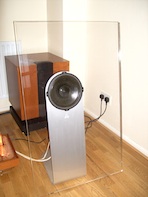
The 'oughties where an interesting time for me, I got married (downsized the system at the time) and started to work part time commercially in Audio, modifying Shanling equipment under the 3D Sonics/3D Acoustics Label and designing what is probably the worlds least commercially successful speaker, the 3D Sonics Transparence which I used myself for quite some time as well with varying tube amplifiers and other electronics.
Later my marriage unravelled and I lost the modest system I had at the time in the process. Business links also went sour. I did much moving around and did much stuff that was interesting, challenging and fun, like helping to design a multi award winning CD-Player and with friends starting up a High End Audio Manufacturer (yes, I know, heck of timing to that just before the world economic meltdown hit).
I found a wonderful girl to be with and now we have a 1 year old daughter. Finally some stability has set in again and I have assembled another (all custom build) system that is quite modest but is really not all that bad...
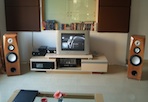
For the time being I no longer have an Analogue Setup, I may get one back some time, but not right know. I no longer even have any CD's at hand (LP's and CD's are in storage). My sole Signal Source now is a custom build Media PC, covering both Video of any form and Audio.
 |
 |
This uses an OrigenAE S-16T case with build in 7" touch screen and remote control receiver. It allows me direct control of the Media PC or using it the way one is used to from any DVD Player or CD-Player via remote. The Remote control for the MediaPC incidentally also can learn the power command for the TV (in my case the projector) and volume control (preamp in my case), minimising the number of remotes.
It uses a pair of Western Digital 2TB AV hard drives mirrored (as backup) to store the media files several 1,000 albums mostly as FLAC Files and many movies and Anime TV series. A short discussion of the original configuration was posted at the site Audioasylum.com. I recently upgraded many of the internal parts, compared to the internal picture and AA discussion, not that it looks any different from the outside and only a little on the inside.
It now uses a fan less ECS 945GCT-D Atom 330 (dual core) Motherboard with a PCI-E Slot, allowing me to use a ATI Graphics card (also fan less) with both digital and analogue outputs, including component video, VGA, and DVI/HDMI all the way to 1080p and for future blu-ray playback (not that my projector and TV handles anything more exciting than 480p).
The power supply has remained from the previous configuration and is also fan less, a so-called "Pico-PSU", with an external and heavily modified 120VA power brick. Maybe one day I'll find the time to build an internal 12V/10A linear supply. So all that makes noise and spins are the hard-drives. Apart from being extra-quiet AV types, the OrigenAE case has a clever mechanical isolation mounting system for the hard-drives that reduces noise transmitted even further. This PC makes less noise than many CD and DVD Players I know.
The software side is Windows 7 with the latest stable version of the Open Source Media Center Software Mediaportal with various community plugins (ASIO Music Player is especially important for the music side, giving bitperfect memory playback).
The Media PC drives an ancient Optoma H30A Video Projector via DVI. It, combined with an 80" motorised screen brings a real cinema experience to watching movies. We watch minimal amounts of over the air TV, the TV connects also to the MediaPC via analogue component video.
 |
 |
In order to output high quality sound from this platform, I use an external USB to SPDIF converter, a prototype of the Morello I designed for diyhifisupply.com. This is connected (with a very short cable) directly to my DAC. This is based on the Satch TDA1541 DAC Kit from diyhifisupply.com. However it has seen a comprehensive internal re-build covered in a little more detail at the Audio Asylum.
It uses the legendary TDA1541 (a double crown chip) without oversampling and with a tube output stage. It handles even 96KHz and 88.2KHz sample rate signals, but can only render the top 16 Bit. While it remains among some of the best ways to play CD's or CD-Files that I know, it is not as stellar with high resolution music and is hence on the list for replacement with something that can do at least 192KHz sample rate and 18 or 20 Bit Multibit DAC's (non-oversampling of course), when I have a few rainy weekends to spare.
 |
 |
The line stage is another diyhifisupply.com product, though you may call it my design, if you so want. It combines a simple tube stage with a simple, remote controllable input selection and volume control. The volume control is based on the same chips as found in the recent top of the line Audio Research Reference Preamplifiers, while the Tube Stage may be likened somewhat to linestage of the Audible Illusions preamp or the Conrad Johnson ART (single stage 6922). It sounds good and is very convenient.
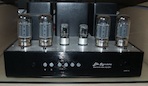
The power amplifier is build on the chassis of the now discontinued diyhifisupply.com Ella Kit, but to my own radically different circuit. It uses a rather unusual circuit for the output stage that allows Class AB Operation for high output power but needs no looped feedback. The frontend is a very simple circuit with a single ECC83 gain stage and simple unity gain phase splitter. There is only one coupling capacitor for each output tube, the rest of the circuit is direct coupled. The coupling capacitors are silver foil types.
The sound quality is excellent and quite similar to a good SE Amplifier, but output power is only around 35W per channel, quite a bit underpowered for my speakers, so an amplifier upgrade is likely on the cards.
The speakers are simple 3-Way types, with a 10" Woofer, 5" Midrange (actually a fullrange driver to be precise) and a circular ribbon tweeter. The crossover is first order, series giving a speaker that is phase coherent and offers good impulse response.
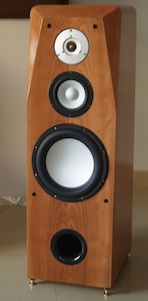
The speakers use inexpensive pre-made MDF enclosures, slightly customized to fit the Drivers I used. They do look a little like Avalon in design, shrug, the boxes came like that. With the drivers I selected, all these diffraction reducing stealth like angled surfaces do not really do much, as the drivers have a quite narrow dispersion angle, looks quite nice though.
To overcome the resonance problems the inside is lined with 20mm thick stone plates glued in place with epoxy resin. The result is an extremely non-resonant and dead box that is also very heavy weight. The speaker has around 89db/2.83V sensitivity, a bandwidth of around 30Hz to 40KHz with a 5-6 Ohm impedance that is flat through the midrange.
The speaker cables are Premium SCSI3 Ribbon cables, using silver plated solid core copper in clear teflon insulation (80 Conductor). The line level interconnect cables are my own designs using gold plated silver wire and air dielectric using Neutrik Pro Plugs. The cables used to be marketed under the 3D Sonics label for a while and got excellent feedback. The Mains cables are AMR PC-77, another one of my commercial cable designs.
The living room is around 50 square-meters with an irregular, open plan shape and 3.2m high ceilings. The Sofa is a little more than halve-way between two walls. Two acoustic panels on the wall behind the speakers reduce the reverberation quite effectively, as do the many soft furnishings. As the speaker has quite well controlled dispersion at higher frequencies it is possible to manage to get good sound without heavy carpet.
Overall the system has a sound that is natural, open and musical. It allows long listening at elevated levels (but not very loud, the Amp runs out of steam) without listener fatigue. The Tone is excellent on all instruments and the system renders the emotional content of music very well, though perhaps not as compelling as a truly top performing SE Amplifier with a pair of huge high efficiency speakers.
The circular ribbon has a lightness of touch and absence of mechanical sound that only ribbons and electrostats manage, cymbals and other percussion acquire a realism that escapes most speakers with more conventional tweeters. The soundstage is wide and deep and extends laterally well past the speakers and in depth well through the wall behind the speakers.
In many ways it is a very self effacing system, better described by what it does not do. There is no patented "HiFi Stunt Bass" (paralyses small animals), no fake extra detail (makes you hear things that were never even recorded), no miniature hologram soundstage (it sounds exactly as if the musicians are here in your room and they are six inches tall and bunched together) or extra dynamics that jump out. Instead there is just music.
|
|


